 SEO Saudi Arabia
+966 57 082 6741Free Audit
SEO Saudi Arabia
For Yanbu businesses that serve customers in person — cleaning and maintenance companies, contractors, clinics, restaurants, tour operators, workshops and showrooms. We fix the Google Business Profile problems keeping you out of the map pack, then build the district and service pages that put you in front of customers ready to call today.
Yanbu pairs an industrial base with a growing Red Sea tourism and diving market. Local search demand splits between B2B industrial services and consumer leisure, and few businesses serve both well.
Yanbu is small enough that a single well-optimised Google Business Profile can dominate a category outright. The businesses winning here are the ones that picked the right primary category, built consistent citations and generated reviews steadily.
Local search is a different discipline from e-commerce SEO. An online store competes nationally on content and links. A local business competes within a few kilometres on Google Business Profile quality, citation consistency, review velocity and location relevance. The businesses winning in Yanbu are rarely the ones with the best websites — they are the ones whose profile is configured correctly and whose reviews arrive every week.
Google ranks local results on proximity, relevance and prominence. Two of the three are in your control.
How close the searcher is to your business. You cannot change this directly — which is exactly why the other two factors decide whether you win outside your immediate street.
How well your profile and pages match the specific search. This is where service entries, categories, district pages and Arabic keyword work do their job.
How well known and trusted your business appears: review volume and recency, citation consistency, local links, and mentions across the web.
These are what we actually find in local audits. Most businesses have five or more.
Google weights the primary category more heavily than any other profile field. A cleaning company categorised as "Commercial Cleaning Service" competes in a different market from one categorised as "House Cleaning Service", and picking the wrong one removes you from the searches that matter. Most owners chose their category once, at signup, and never revisited it.
Google cross-references your business details across directories, social profiles and old listings. An old phone number on one directory, a previous address on another, and a slightly different business name on a third all reduce confidence in your location data. This is the single most common silent ranking suppressor we find, and it is invisible unless you audit for it.
Google suspends and soft-restricts profiles regularly, often for address configuration errors, keyword-stuffed business names, or service-area setup mistakes. Duplicate listings created years ago by staff or aggregators split your reviews and ranking signals across two profiles. Owners often operate for months without realising their profile is restricted.
"Villa deep cleaning", "sofa cleaning" and "water tank cleaning" are three distinct searches with three distinct competitor sets. A single services page competes for all three and ranks well for none, because it cannot be specifically relevant to any of them. The same applies to trades, treatments, practice areas and product lines.
Service-area businesses that select an entire city, or leave the field empty, give Google a low-confidence signal and get restricted to a small radius. Businesses with a storefront often make the opposite error and hide their address unnecessarily, which triggers verification problems.
Review recency and velocity matter as much as rating. A business with 90 reviews from the last year at 4.5 stars will usually outrank and outconvert one with 200 reviews from four years ago at 4.8. Most local businesses have no system for asking, so reviews arrive at random.
A large share of local searches filter for businesses open at that moment. If your listed hours are conservative, or your Ramadan and holiday hours were never updated, you are removed from those results automatically. For emergency services this is the difference between getting the call and never appearing.
Proximity is a ranking factor you cannot change — but relevance is. Businesses with genuine district-level pages appear for searches originating across the city, while businesses with a single city page are confined to their immediate area.
Machine-translated Arabic misses how people actually search. Customers use dialect, mix Arabic with transliterated English, shorten district names and phrase requests conversationally. Translated service names rarely match any of that, and RTL formatting errors make the page look unprofessional.
Most local businesses measure rankings, which move constantly and mean little on their own. What matters is calls, direction requests, WhatsApp messages and bookings, attributed to source.
Every category has different search behaviour, different competitors and different failure points. Here is what changes for yours.
Industrial buyers are not searching for a nearby supplier to visit. They are researching capability, certification and track record on behalf of a committee. Consumer local SEO tactics do not apply.
What wins here is capability depth: equipment lists, certifications, safety records, project case studies and clear technical specifications. Search volume is low and highly specific — buyers search exact equipment names and standards. Ranking for those exact terms with a page that answers procurement questions is worth more than ranking for any broad category term.
When an AC fails in July, nobody researches. They search, they call the first number with decent reviews that answers. The entire funnel is: search, glance, tap-to-call. This means your ranking, your review rating and whether your phone is answered are the three things that decide the sale — your website barely matters.
Maintenance companies lose most often on two technical details. First, opening hours: if your profile says you close at 6pm, you are filtered out of every "open now" search after 6pm, which is exactly when household emergencies get noticed. Second, service-area businesses without a storefront often set up their profile with a hidden address incorrectly, which Google penalises or suspends. We see suspended or soft-restricted profiles constantly in this category, and the owner usually has no idea.
Tourism businesses are searched by people who are not from your city and often not searching in Arabic. They use different vocabulary, different place names, and they book from a phone while travelling. A tour operator optimised only for Arabic-speaking residents misses the entire inbound market, and one optimised only in English misses domestic tourism, which is the larger share of Saudi travel spending.
The structural mistake here is bundling everything into one listing. A single "tourism company" profile competes for nothing specific. Desert safaris, heritage tours, diving trips, mountain hikes and airport transfers are separate searches with separate competitors and separate seasonality. Each needs its own page and its own service entry. Tourism is also the category where photo volume and recency move rankings most visibly — profiles with steady new photos consistently outperform identical competitors with stale galleries.
Cleaning is an emergency-adjacent purchase. Someone books a deep clean before guests arrive, before a lease inspection, or after a water leak. They open Google Maps, look at the top three results, check the star rating, and call. If you are not in that top three you are not in the consideration set at all — there is no second page in local search.
The failure we find in almost every cleaning company audit is the same: one Google Business Profile, one generic "cleaning services" category, no service list, and a service area either left empty or set to the entire city. Google cannot tell whether you do villa deep cleaning, sofa shampooing, water tank sterilisation or post-construction cleanup, so it ranks you for none of them specifically. Meanwhile a competitor with those exact services listed on their profile captures every one of those searches.
Restaurant discovery happens almost entirely in Google Maps and the decision is made in seconds from three things: rating, photo quality and distance. A half-star difference measurably changes footfall. Most restaurants have no system for generating reviews and respond to none of them.
Two fixable problems dominate. First, menu data: restaurants that add their full menu as structured data appear for dish-level searches, while those without appear only for generic category searches. Second, photo control: the majority of photos on a typical restaurant profile were uploaded by customers, meaning the first impression is outside your control. Owners who upload consistent, well-lit photos weekly shift that balance and see click-through improve.
Your biggest local search competitor is the online travel agency listing your own property and charging you commission for the booking. Direct booking recovery is the whole game.
OTAs outrank hotels for their own property names surprisingly often. Fixing that requires a complete Google Business Profile with booking links, consistent naming across every citation, and content the OTA cannot replicate — genuine area guides, distance-to-landmark detail, and direct-booking incentives. Distance-based content matters enormously for religious and event tourism, where proximity is the primary selection criterion.
A villa renovation is a six-figure decision. Nobody calls the first result. They shortlist three, check reviews carefully, look for completed project photos, and often verify commercial registration. Local search gets you onto the shortlist; credibility content wins the job. Most contractors have the first half and none of the second.
Contractors typically have strong word-of-mouth and nearly zero search presence, which caps growth at whatever their network produces. The specific gap is project evidence: no photo galleries organised by project type, no district-level project pages, no pricing guidance of any kind. When a competitor publishes "villa renovation cost guide" content and you publish nothing, they capture the customer months before the buying decision and you never enter the consideration set.
Medical searches are high-intent and high-value, but Saudi health advertising regulations restrict what you can claim. Many clinics respond by publishing nothing at all, which cedes the entire search market to competitors willing to publish compliant, informative content.
Patients search symptoms, not services. Someone searches for tooth pain, not "endodontics". Clinics that only list clinical service names miss the searches that actually happen. The second gap is practitioner-level presence: patients search doctors by name and specialty, and clinics without individual doctor pages lose those searches to aggregator directories that rank instead of you.
Drivers search by their specific car, not by workshop. "Toyota service near me" and "BMW specialist" are different searches with different competitors, and a generic "car repair" profile ranks for neither strongly.
Auto is the category where specialisation beats breadth most clearly. A workshop that lists every brand it can service ranks weakly for all of them. A workshop that builds pages for the four brands it genuinely specialises in dominates those searches. The other consistent gap is roadside and emergency intent — battery, tyre, towing — which is pure map pack and pure open-now filtering.
Nobody has a regular moving company. Every customer is new, every decision is made under time pressure, and trust has to be established from a cold search. Reviews do almost all the work.
Movers compete against a large informal market, which means the differentiators that rank and convert are the ones informal operators cannot show: a registered profile, real reviews, insurance, transparent pricing and photos of actual trucks and crews. Route-level pages also matter and are almost never built — intercity moves are searched as specific origin-destination pairs.
Physical retail competes with e-commerce on price and loses, so it has to win on immediacy: the customer who wants the item today. That means appearing for "near me" and "open now" searches with accurate stock and hours.
Product-level visibility is the underused lever. Retailers who publish their product range as structured data appear for specific product searches, while those who publish only a category description appear for almost nothing. Hours accuracy also matters more here than owners assume — a single wrong holiday closure generates negative reviews and suppresses local ranking.
Pest problems are urgent and customers want them solved discreetly and immediately. They search the specific pest, not "pest control", and they call whoever looks legitimate and available now.
Pest-specific pages are the entire opportunity and almost nobody builds them. Bed bugs, cockroaches, termites, rodents and snakes are separate searches with separate urgency levels and separate price points. A single "pest control services" page competes for all of them and ranks strongly for none. Safety information — whether treatments are safe for children and pets — is also among the most searched pre-booking questions and is almost never answered on site.
The highest-leverage asset in local search, and the most neglected.
Most Yanbu businesses claimed their profile once and never returned to it. Wrong primary category, no service list, no products, a two-line description, photos from three years ago, unanswered questions and unresponded reviews. Each gap costs map pack positions, and together they explain most of the ranking gap between you and the competitor above you.
We rebuild the profile field by field, then maintain it. Profiles are not a one-time setup — Google rewards active management, and dormant profiles lose ground to maintained ones even with identical fundamentals.
Google cross-checks your name, address and phone number everywhere it appears. An old mobile number on one directory, a former address on another, and a slightly different trade name on a third all reduce confidence in your location data. This suppresses rankings quietly, and it is invisible unless someone audits for it — which is why it is the most common problem we find in Yanbu.
We map every existing mention, correct or remove the conflicts, and build fresh citations across Saudi business directories, chamber of commerce listings, sector platforms, Apple Maps, Bing Places and the Arabic directories most agencies skip. Every listing carries identical details in both languages, and we re-audit quarterly because directories drift.
Most local searches in Yanbu happen in Arabic, and they look nothing like translated English. People search in Hijazi dialect, mix Arabic with transliterated English, shorten district names, and phrase requests conversationally — increasingly by voice while driving.
Someone needing a plumber does not search the formal term for plumbing services. Someone booking a deep clean before Ramadan uses phrasing no translation tool produces. Our native team researches how customers in Yanbu actually phrase these queries, then writes your profile description, service names, district pages, Google Posts and review responses around those real terms — with correct RTL formatting, so the Arabic reads as though a person wrote it.
Review count, rating, recency and content all feed map pack prominence, and they decide conversion once you rank. A Yanbu business with 90 reviews from the past year at 4.5 stars will usually beat a competitor with 200 reviews from four years ago at 4.8, because volume and recency signal an active business.
Almost no local business has a system for this, so reviews arrive at random and stop entirely during busy periods. We build a compliant flow: WhatsApp or SMS requests timed to the moment of service when satisfaction peaks, QR codes on-site and on invoices, and post-visit follow-ups. Then we respond to every review in the reviewer's language, which measurably improves conversion and is itself a ranking signal.
We do not buy reviews and we do not gate negative feedback behind a filter. Both violate Google policy and risk profile suspension, and we have cleaned up enough suspended profiles to know it is never worth it.
Real district pages with local detail — not one paragraph with the district name swapped in.
Serving all of Yanbu and the wider Madinah Region. Need a district not listed? We build pages for any service area you genuinely cover.
Clear, transparent, results-driven. Here is exactly what happens.
Profile and category review, citation scan, suspension and duplicate check, review analysis, map pack grid scan across Yanbu and a breakdown of your top three competitors.
Category corrections, bilingual descriptions, full service list, photo plan, district priority map and a keyword set in Hijazi Arabic and English. You approve first.
NAP conflicts corrected, duplicates merged, suspensions resolved, Saudi directory listings built, Apple Maps and Bing Places claimed, local schema added.
District and service pages published, Google Posts running, Q&A seeded, and a compliant review flow live with bilingual response management.
Calls, direction requests and WhatsApp taps attributed to search, plus map pack grid positions by district and the plan for the coming month.
| Feature | SEO Saudi Arabia | Typical Agency |
|---|---|---|
| Focus | Local search specialists | Generic SEO |
| Arabic | Native Hijazi speakers | Google Translate |
| Coverage | District-level pages | One city page |
| Services | A page per service | One services list |
| Reviews | Compliant generation & responses | Ignored or bought |
| Suspensions | Diagnosis & reinstatement | Not offered |
| Metric | Calls & direction requests | Rankings only |
| Reporting | Grid positions by district | Single average position |
| Contracts | Month-to-month | 6-12 month lock-in |
| Pricing | Transparent on site | Hidden |
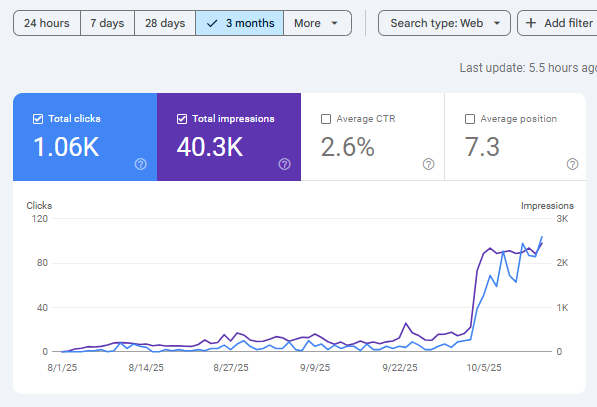
Real screenshots from Saudi clients. Not mockups.


Local SEO wins customers nearby who need you today. If you ship products across the Kingdom instead, our e-commerce SEO service is the right fit. Businesses with both a storefront and an online store usually run the two together.
Local SEO in Yanbu starts at SAR 1,530/month during our Saudi National Day offer, reduced 49% from SAR 3,000. Multi-location plans run to SAR 6,120+/month. All plans are month-to-month with no lock-in, and every plan starts with a free audit.
Profile and citation fixes usually show movement within 30-60 days. District pages and review growth compound over three to six months. Yanbu is a small market where a single well-optimised profile can dominate an entire category.
No. Service-area businesses — cleaning companies, maintenance contractors, movers, mobile services — can rank without a storefront. But the profile must be configured as a service-area business correctly, with the address hidden the right way and coverage set by district. Getting this wrong is one of the most common causes of profile suspension we see.
Usually category accuracy or citation consistency, not reviews. Google weights the primary category heavily, and inconsistent name, address and phone data across the web quietly caps rankings regardless of how good your reviews are. Review recency also matters more than total count — recent reviews outweigh a larger but older set.
Yes. Suspensions in Yanbu are usually caused by keyword-stuffed business names, address configuration errors, or incorrect service-area setup. We diagnose the cause, prepare the reinstatement request with supporting documentation, and correct the underlying issue so it does not recur. We also merge duplicate listings that split your reviews.
In Yanbu we work most with Industrial and B2B Services, Maintenance and AC Companies, Tourism, Tours and Hospitality and Cleaning Companies. Each gets a different strategy — an emergency maintenance company needs open-now visibility and fast response, while a contractor needs project evidence and cost-guide content for a much longer decision cycle.
Yes, written by native speakers rather than translated. Our team writes in Hijazi Arabic for your profile, service names, district pages and review responses, and handles RTL formatting properly. Most local searches in Yanbu happen in Arabic and they do not match literal translations of English service names.
Calls, direction requests, WhatsApp taps and bookings attributed to local search, plus map pack grid positions across Yanbu districts rather than one average ranking number. Rankings that do not produce calls are not results, so we report the outcome first.
Yes. Each branch gets its own optimised profile and district page so branches rank in their own neighbourhoods instead of cannibalising each other. We also clean up the duplicate and orphaned listings that multi-branch businesses almost always have.
A review of your Google Business Profile setup and category accuracy, citation consistency across the web, suspension or duplicate check, review profile analysis, a map pack grid scan across Yanbu districts, and a breakdown of your top three local competitors. It is worth SAR 2,500 and there is no obligation.
Free local SEO audit worth SAR 2,500. We will show you exactly which of the 10 problems above apply to your business. No obligation.